She wasn't pure. She was whole. (A different kind of Mother's Day reflection)
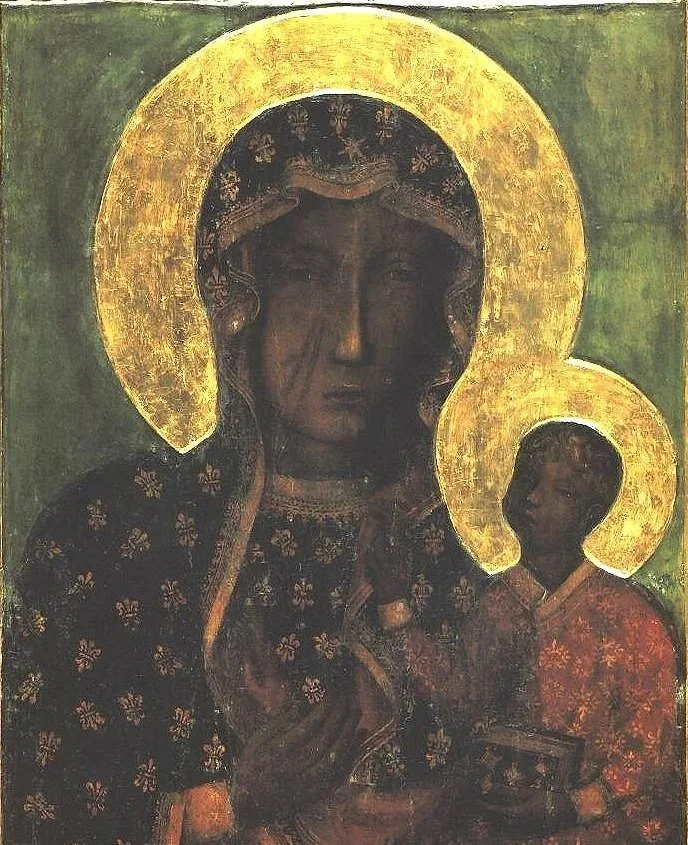
Most of us grew up with a particular image of Mary - serene, pale, untroubled. A mother who seemed to arrive already complete, already luminous, as though she had bypassed the difficult parts of being human.
But there is another Mary. Older, darker, less domesticated. She is found in shrines across Europe, carved from black wood or painted on Byzantine icons. Her skin is dark. Her gaze is direct. She does not look away from suffering.
She is called the Black Madonna.
She appears most famously at Częstochowa in Poland and Montserrat in Spain, where millions of pilgrims have traveled for centuries - not to find perfection, but to be met in the hardest places of their lives. In 2011 alone, an estimated 3.2 million pilgrims from 80 countries made the journey to Częstochowa. Scholar of mysticism Andrew Harvey describes her darkness as pointing to the divine as "forever unknowable, mysterious, beyond all our concepts, hidden from all our senses in a light so dazzling it registers on them as darkness." Theologian Matthew Fox calls her the Queen of Nature, who demands a return to balance and wholeness.
She is the Mary the Church could not quite contain.
What if "virgin" never meant what we were told it meant?
In the ancient world - long before Christian theology calcified the term - a virgin was not a woman defined by her sexual inexperience. She was a woman who was whole unto herself. Complete. Sovereign. Uncontained by anyone else's definition of her. Artemis, Athena, Persephone - all were called virgins in this sense, even when they loved, even when they mothered.
The original Hebrew word for Mary, almah, simply means "young woman," a term pointing to vitality and readiness for life, not to physical purity. When it was translated into Greek as parthenos, and then into the Latin virgo, something essential was progressively narrowed - the inner life, the initiatory dimension, the sense of a woman who had done something profound within herself before she brought new life into the world.
What was that something? In both mystical and Jungian frameworks, it points to shadow work. To descent. To the willingness to meet the unlived, the unacknowledged, the dark - and to integrate it rather than flee.
Mary, in this reading, was not pure because she avoided the darkness. She was whole because she moved through it. The Catholic doctrine of the Immaculate Conception - so often read as being about sexual purity - may be a distorted echo of something far more interesting: that she had already cleared the ground. Already died to a smaller version of herself. Already, as the alchemists would say, passed through the nigredo — the blackening, the burning away of the false self — before she could birth the light.
This is what the Black Madonna knows. She is not the Mary of ethereal grace. She is the Mary who descended first.
And this reframes everything. If Jesus was born "without shadow," it was not because shadow was beneath him, it was because his mother had already done the integrative work that most of us spend our whole lives attempting. What he carried on the cross was not his own shadow, but ours. The collective unlived darkness of humanity. He could hold it because he came from wholeness.
I find this so much more moving than the sanitized version. Not a pristine woman in blue who floated above the fray. But a woman who descended into her own depths, did the hard interior work, and emerged - transformed, whole, ready to bring something new into the world.
That is a mother worth honoring.
On this Mother's Day, whatever your relationship with your own mother - complicated or tender or somewhere in between - I invite you to sit with this question:
What in me is being asked to complete its descent before it can birth something new?
What part of my shadow is waiting, not to be fixed, but to be met?
The Black Madonna is not there to give you answers. She is there to remind you that the darkness is not the obstacle. It is the path.
Sources & further reading
Pilgrimage figures: Jasna Góra Monastery records, as reported by Wikipedia's entry on Jasna Góra (2011 estimate).
Andrew Harvey quote: The Return of the Mother (1995), cited in Matthew Fox, "The Return of the Black Madonna," matthewfox.org (2011).
Matthew Fox on the Black Madonna as Queen of Nature: "The Return of the Black Madonna," matthewfox.org.
On almah and translation: Hebrew-Greek linguistic scholarship is summarized well in the Wikipedia entry on "Almah" and in the University of Arizona's Bible Interpretation journal (bibleinterp.arizona.edu).
On the Jungian feminine and the Black Madonna: Marion Woodman, The Pregnant Virgin (1985); Ean Begg, The Cult of the Black Virgin (1985).
For a moving literary encounter with the Black Madonna: Sue Monk Kidd, The Secret Life of Bees (2002); China Galland, Longing for Darkness (1990).
