I Am A Rockstar
I signed us up for the beginner lesson.
Not because I hadn't surfed before. I had - twice. My first time surfing was in Hawaii on my honeymoon with my former husband when I was a ripe 22 years old. When I showed the picture to people afterwards, everyone laughed and commented on how small the wave was. I didn’t care - I was grinning ear to ear.
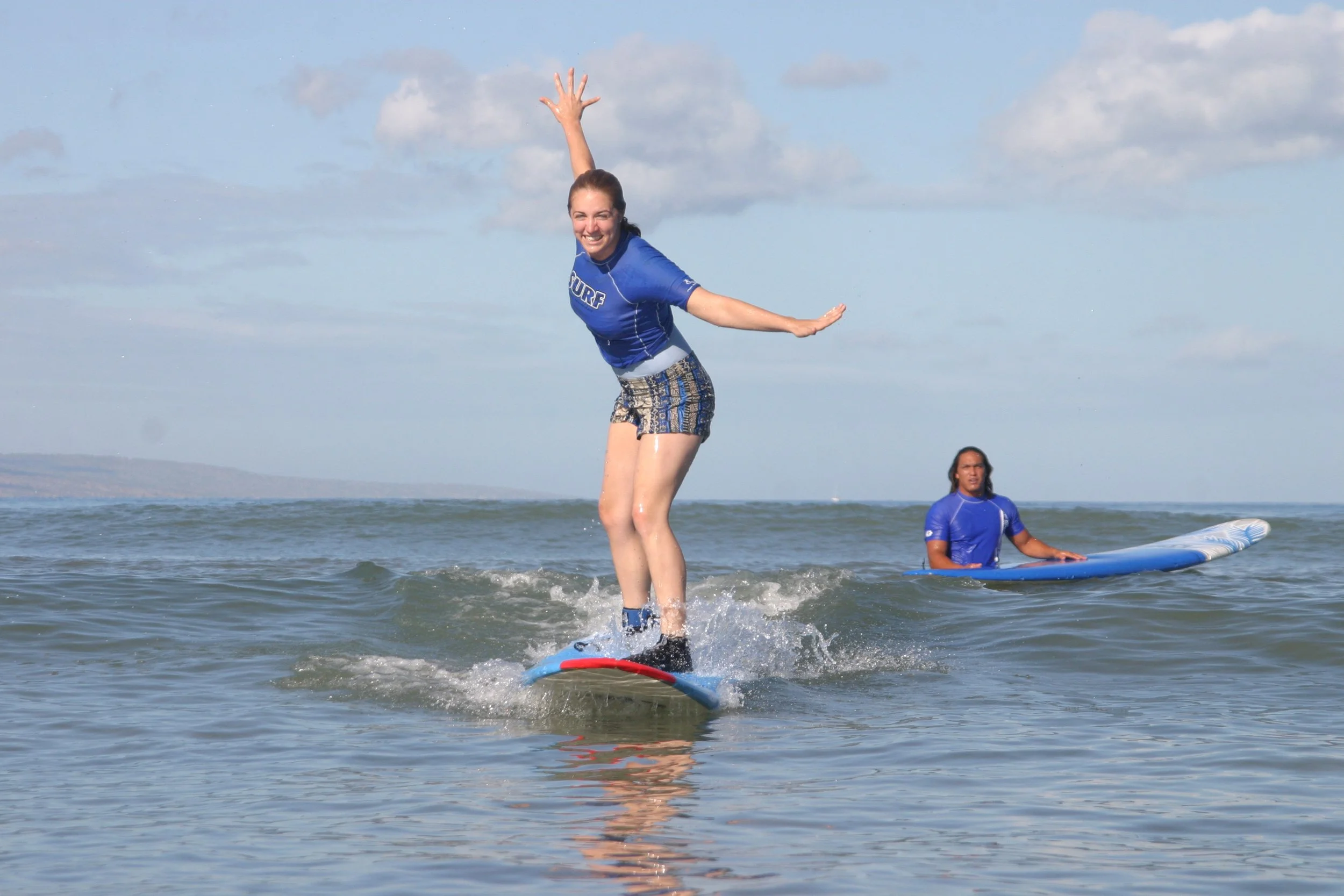
Check out the awe on my instructor’s face at my ability to surf a 2-inch wave. 2005.
My second surfing experience was more than a decade later at a four-day surf camp in 2022 where I graduated to green waves and a smaller board. But that was four years ago. My body has more pain than it used to. I often wake up with a tight low back and stiff ankles. I wanted to be kind to my body. So I signed my teenage son and me up for the beginner class, and I made peace with that.
The instructor looked at me after the first few waves and said I should have signed up for intermediate.
I didn't know what to do with that.
Here's what I know about myself: I work hard. I have always worked hard. Straight A student in high school, West Point, military deployments, motherhood, divorce, rebuilding — none of it came easily, and I earned every piece of it through effort and will and sheer refusal to stop. Even my healing has been work. Even my spiritual practice. Even the business I've built around helping other people come home to themselves — that has required tremendous, sustained, intentional effort.
So when something just works — when my body simply knows what to do without my mind having to orchestrate it — I don't always recognize it at first. It doesn't feel like the things I'm used to. It feels too easy, like maybe it doesn't count.
Surfing, it turns out, doesn't care about any of that.
There is almost no time to think.
The wave is coming and your body either responds or it doesn't. You read the water, you paddle, you feel the push, you pop up — and if you're lucky, you're riding. If you're not, you're underwater, tumbling, and then you surface and paddle back out and do it again. Each wave is a complete lesson. Each wipeout is just information. No shame in the falling. No failure in the foam.
For two whole hours, my mind was quiet.
I don't mean relaxed-quiet. I mean gone. The kind of quiet I seek in meditation and sometimes find and often don't. The kind of quiet that I recognize, in my somatic training, as a regulated nervous system — present, responsive, fully in the body. No past. No future. No running commentary. Just the ocean, the board, the wave, and me.
At some point — after one particularly good ride, the kind where everything lined up and I felt myself start to learn how to turn — I hopped off my board, threw my arms in the air, and shouted at nobody and everybody:
I AM A ROCKSTAR!
And then I started to cry.
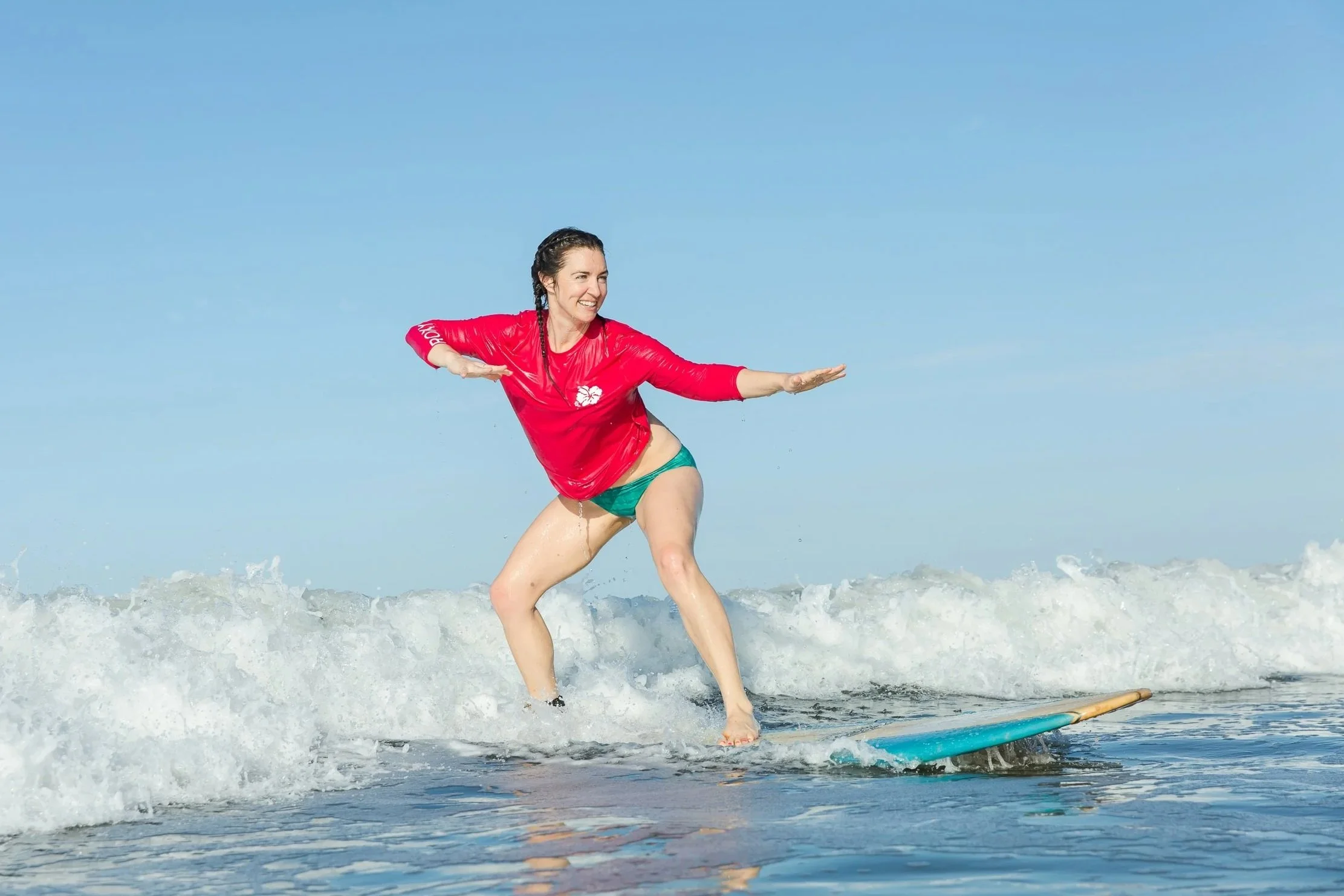
I've been crying a little bit, on and off, ever since. Every time I really let myself return to that moment, the tears come back. I've been sitting with my curiosity about that.
Here's what I think was happening in that cry:
My body demonstrated something to me. Not something I'd earned through grinding. Not a skill I'd studied or a competence I'd built through discipline. Just — a native capacity. Something that was already there. My body, the same body that carries more pain than it used to, the same body that has been through so much, just got called gifted by a stranger in the ocean. And something in me didn't know how to receive that without weeping.
There is grief in that. Grief for all the times things weren't effortless. Grief for how long it's been since I felt naturally good at something — good in the way that doesn't require justification or proof. And underneath the grief: relief. The specific relief of the exhale. Of the nervous system saying: you can put it down for a moment. You don't have to try so hard right now. You're already enough.
In Hakomi, we talk about the body as the keeper of what the mind hasn't caught up to yet. The body knows before the mind does. The tears on the beach weren't confusion — they were recognition. Something in me had been waiting a long time to feel that free.
I also want to say this: I am good at dancing and yoga asanas.
I laughed when I remembered that, because of course. Surfing and dancing and warrior 2 share a grammar — both are body-first, rhythm-based, responsive. You don't think your way through a wave any more than you think your way through a song. You listen your way through. You follow the lead of something larger than you.
I wonder how many of us have native intelligences like this, capacities that live in the body and bypass the mind entirely, that we rarely get to access because so much of life asks us to be cerebral, strategic, effortful. I wonder what it costs us to be so rarely in our bodies that when we finally arrive there, we cry from the relief of it.
I don't have a tidy answer. I just know that for a couple hours in the Pacific ocean off the coast of Costa Rica, the ocean kept offering me waves, and my body kept knowing what to do, and my mind finally shut up long enough for me to feel it.
That's worth more than I can say.
If something in this essay landed for you — if you have your own version of this, your own place where your body knows something your mind has forgotten — I'd love to hear it. That's exactly the kind of homecoming I'm here for.
And if you're ready to find your way back to your body and the wisdom that resides within and looking for support, I'd be honored to walk alongside you. Find out more about working with me at embodiedwayfinding.com.
